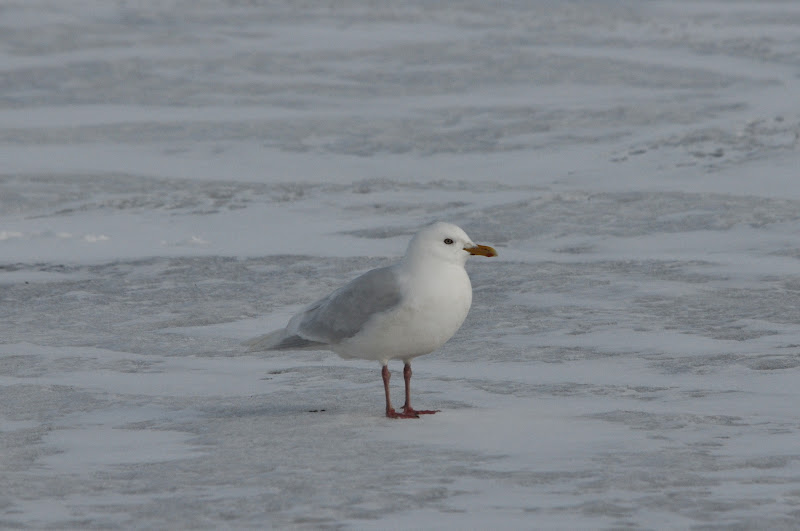
A truly beautiful day, wich was supposed to be my day off.... But starting a new job has shown that a day off, is not nescesarily a day off. But I did get the time to do some birding. Quite a few nice birds out there today, and the sun was lighting them all very nicely. But as usual most of the birds were too distant to get good photos of them. But then an Iceland Gull (Grønlandsmåke) suddenly sat just few metres in front of me, and I once again managed to take about a hundred pictures of this beautiful bird! this is not the heaviest one of this species that are staying up here, but I still got to see how similar this one could be to a Glaucous Gull (Polarmåke) in certain angles. But it is still a lovely Iceland Gull! Enjoy!!
Viser innlegg med etiketten Iceland Gull. Vis alle innlegg
tirsdag 5. juni 2012
torsdag 31. mai 2012
May 27th and 28th
The winter does not seem to want to resign this year, and a cold wind is still making birding a cold experience. But now the migrants have really started to come, and new species are coming up to this still frozen place.
At least two different Iceland Gulls (Grønlandsmåke) are staying in the area, even though the one in these photos made me think of a possinble hybrid with Glaucous Gull (Polarmåke) due to its heavy bill and the fact that when it moves its head while sitting, it sometimes looks more like a Glaucous than an Iceland. But long wing-projection, a large eye and red legs tell me that this is "just" an Iceland Gull.
The numbers of geese in the valley have increased over the last few days, and by now there have to be thousands around. The Pink-footed Geese (Kortnebbgås) were the first to come in numbers, but also the Barnacle Geese (Hvitkinngås) are now here in large numbers.
I was also pleased when I got to see this years first Brent Geese (Ringgås) These geees that are just a bit bigger than a Common Eider (Ærfugl) are really birds with an attitude, and fights between the males are frequent. And all the time they are feeding you can hear theire grunts, unlike any other sound from any goose that I know of.
And finally the Red-throated Diver arrived. I have been waiting for it for some days, and suddenly one was lying in shallow water in the delta.
I will come back with more on the latest arrivals in a later post, and then hopefully with some pictures to show you as well.
lørdag 19. mai 2012
May 19th
Even though the wind now has blown for more than two weeks without stop, there are still some birds that manage to hang on up here. Was out for a short birding-trip today, and we actually managed to see some nice birds and animals.
For me, the biggest probably wa to find one of the adult Iceland Gulls (Grønlandsmåke) again. It was not at its most helpfull when it came to photographing, but we both got OK pics of it. For Chris I think the Arctic Fox (Fjellrev) that we saw might have been the highlight of the trip. Even though it did not come in close, we at least got some nice views of it.
Since Chris is a sea-bird-watcher, he did not miind too much when I suggested to go to Vestpynten to see what would come flying by at sea. Due to the strong wind and the cold we did this in two episodes, where the secoond try was definately the best. We agreed on that there had to have been more than 1000 Fulmars (Havhest) that flew in front, over and behind us. We felt like we were actually in the way of theire fly-way. To have these Fulmars flying at arm-length away was a mighty experience. In between these there were good numbers of Kittiwakes (Krykkje) and a few Glaucous Gulls (Polarmåke).
when we ended the birding we said "Hello" to a King Eider (Praktærfugl) which was trying to court a Common Eider (Ærful) female at Gammelkaia. Maybe it is the same guy as was in the Eider-colony last year?
Today I learnt that a four-whell-drive car is nessecary when birding in the Arctic, since a white-out and snowdrifts tend to get your car stuck in the middle of nowhere. And I again learned that watching seabirds can be great fun, as long as you have the correct company! :)
Here are some pics from todays windy birding:
| This is evidence that the Arctic Foxes are stil around :) |
| Iceland Gull, doesnt it look nice? |
| "Angry" eye on the Iceland Gull. |
| Fulmar at seven metres distance |
| Fulmar at three (!) metres distance! |
| Fulmar avoiding collision with the photographer. |
| Kittiwake |
| Glaucous Gull |
| Glaucous Gull |
| King Eider showing off!! |
| King Eider showing off from the other side. |
| Can you spot the mistake he has done? |
søndag 1. april 2012
1st of April, but no fooling!
It is so nice that the gulls are back in numbers again, even though the numbers are small still. Today I had 13 Glaucous Gulls (Polarmåke) feeding on bread in front of me, in addition to a subadult Iceland Gull (Grønlandsmåke) and a strange-looking Herring Gull (Gråmåke). I am not sure of the true nature of the species of this "Herring Gull". It felt like a HG when it was flying, but the markings both above and below the wings were very small. The markings on top of the wings consisted of very little black, with large white mirrors, and some long black tongues where I expected to see pure black. The markings on the underwing were very faint, almost pale brown and not covering a large part of the normal area. This led mythoughts into a possible hybrid glaucous x herring. I have seen a few such hybrids before, but none of them have shown a pattern similar to this. While trying to figure out the nature of this bird I came across a few pictures that fitted pretty well, but I still have my doubts about it. These pictures were of Thayer's Gull (Eskimomåke). I feel that this gull may be too large for a Thayers, but I am not the one to come with proper suggestions on this gull. If there is one thing I have learned about gulls, and Herring Gulls in particular, it has to be that gulls vary so much that you can seldom be too certain if youre not an expert. And I am clearly not one! I have allready asked a couple of people about comments regarding this gull, but feel free to comment if you have a good idea of what it is that I have seen.
Pictures of the subadult Iceland Gull:
Pictures of the lovely but brutal Glaucous Gulls:
Pictures of the subadult Iceland Gull:
Pictures of the difficult "Herring Gull":
Pictures of the lovely but brutal Glaucous Gulls:
mandag 2. januar 2012
A new year, new birds to see and new birds to ring.
Happy new year to all of you out there!
2011 was a year when I managed to see a lot of nice birds in different places, and when I got to have my hands on many nice birds as well.
Favourite birds of the year have to be the Iceland Gulls (Grønlandsmåke) I have found up here in Longyearbyen. The gentle appearance, and the soft coloration together with the puppy-eyes have made me like this gull very much. Other than this it has been very good to add more passerines to my Svalbard-list, and the final count of the year was 55 species in 2011, and 68 species in total.
I also had the pleasure of traveling a bit in the year that is over, and spectacularly colorful birds in the Andaman Islands was a very nice opposite to the mainly black, white, grey and brown birds that I am used to from up here, and I even got to add a few birds to my UK-list.
This years ringing-season did not go as I wanted it to do, but the result is still quite good I think. I got to ring several Glaucous Gulls (Polarmåke) when I managed to crack the code on how to catch them, and the Purple Sandpipers (Fjæreplytt) and Dunlins (Myrsnipe) responded well to our catching-attempts. Even a few Snow buntings (Snøspurv) got nice shining rings on their feet here at 78 degrees north.
As a result of the ringing that the group has done up here, we have gathered some very interesting data on the birds, and there are many reports coming back from our flag-tagged birds from their wintering grounds. Through a friend in England I even managed to get the BTO and Birdguides to post a report on our birds, and how they were to be reported back to the head of the team. http://www.birdguides.com/webzine/article.asp?a=3017
I hope that the year to come will be an eventfull one, and if anybody are planning on looking for birds here in Svalbard you are more than welcome to contact me for advice on where to look for the different species that are the specialities up here.
2011 was a year when I managed to see a lot of nice birds in different places, and when I got to have my hands on many nice birds as well.
Favourite birds of the year have to be the Iceland Gulls (Grønlandsmåke) I have found up here in Longyearbyen. The gentle appearance, and the soft coloration together with the puppy-eyes have made me like this gull very much. Other than this it has been very good to add more passerines to my Svalbard-list, and the final count of the year was 55 species in 2011, and 68 species in total.
![]() |
| Iceland Gull/Grønlandsmåke, presumable male |
I also had the pleasure of traveling a bit in the year that is over, and spectacularly colorful birds in the Andaman Islands was a very nice opposite to the mainly black, white, grey and brown birds that I am used to from up here, and I even got to add a few birds to my UK-list.
![]() |
| Asian Fairy Bluebird/Blåalvefugl, male |
This years ringing-season did not go as I wanted it to do, but the result is still quite good I think. I got to ring several Glaucous Gulls (Polarmåke) when I managed to crack the code on how to catch them, and the Purple Sandpipers (Fjæreplytt) and Dunlins (Myrsnipe) responded well to our catching-attempts. Even a few Snow buntings (Snøspurv) got nice shining rings on their feet here at 78 degrees north.
![]() |
| Glaucous Gull/Polarmåke, 3cy, the only young GG to get a ring this year. |
As a result of the ringing that the group has done up here, we have gathered some very interesting data on the birds, and there are many reports coming back from our flag-tagged birds from their wintering grounds. Through a friend in England I even managed to get the BTO and Birdguides to post a report on our birds, and how they were to be reported back to the head of the team. http://www.birdguides.com/webzine/article.asp?a=3017
I hope that the year to come will be an eventfull one, and if anybody are planning on looking for birds here in Svalbard you are more than welcome to contact me for advice on where to look for the different species that are the specialities up here.
søndag 19. juni 2011
June 16th
The Iceland Gull (Grønlandsmåke) is still treating me to some nice views, and to see it together with Glaucous Gulls (Polarmåke) are allways nice so that I can compare the different features and sizes of the species.
Allso the Ivory Gulls (Ismåke) are frequenting the delta quite regularly, and I am allways eager to get good pics of these snow-white birds. This one I noticed due to the loud, thin Black-headed Gull (Hettemåke) -like calls.
| A comparison of the size and jizz of Iceland and Glaucous Gulls |
| Is this my good side? |
| ....or was it this one? |
Allso the Ivory Gulls (Ismåke) are frequenting the delta quite regularly, and I am allways eager to get good pics of these snow-white birds. This one I noticed due to the loud, thin Black-headed Gull (Hettemåke) -like calls.
Abonner på:
Innlegg (Atom)